
Plan your astrophotography nights around the sky you actually have
Owl Astro tells you which targets are worth imaging tonight and in the weeks ahead, from your horizon, with your gear, accounting for the moon and the clouds.
Free, runs in your browser, installs on your phone, and works offline in the field.
What it does
Every clear night, ranked
A calendar scores your targets per night: hours above your horizon in real darkness, peak altitude, moon phase and separation, and the cloud forecast for the coming days.
Framing before you go
See your exact field of view on real sky surveys, rotate it, and get a mosaic grid when the target is too big for one frame.
Your horizon, not a flat one
Draw the trees and rooftops around each site, or import a Stellarium or N.I.N.A. horizon file. Planning uses what you can actually see.
Far beyond Messier
NGC/IC, Caldwell, Herschel 400, Sharpless, Barnard, LDN, vdB, Arp and more, searchable by common name. Comets and events like occultations and close conjunctions too.
Gear that fits the target
Compare telescopes and cameras by field of view and image scale, and see at a glance whether a target is too small, fits, or needs a mosaic.
Light pollution per site
Check sky brightness and light domes around your sites with data from the Light Pollution Atlas.
Guides
All guides →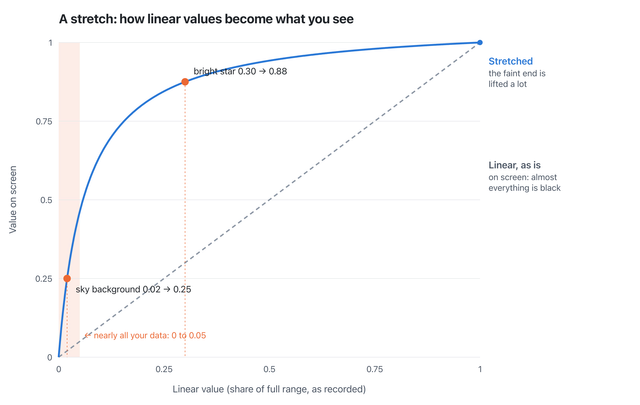
Linear and non-linear: the two halves of processing
What it means that your stacked image is linear, what the stretch changes, and why some processing steps only work before it and others only after.
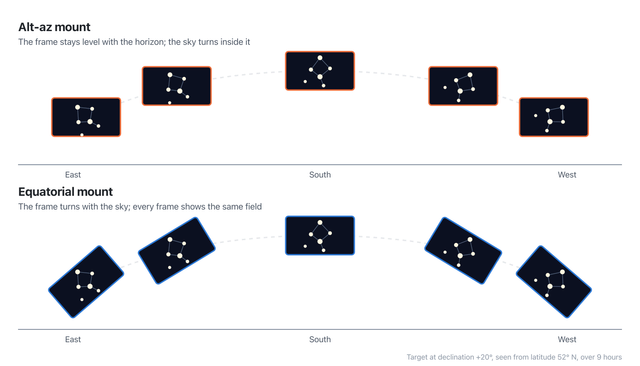
Alt-az versus equatorial for astrophotography
Why an alt-az mount rotates your field of view, how fast it happens, when it actually hurts your images, and when it's worth switching to equatorial.
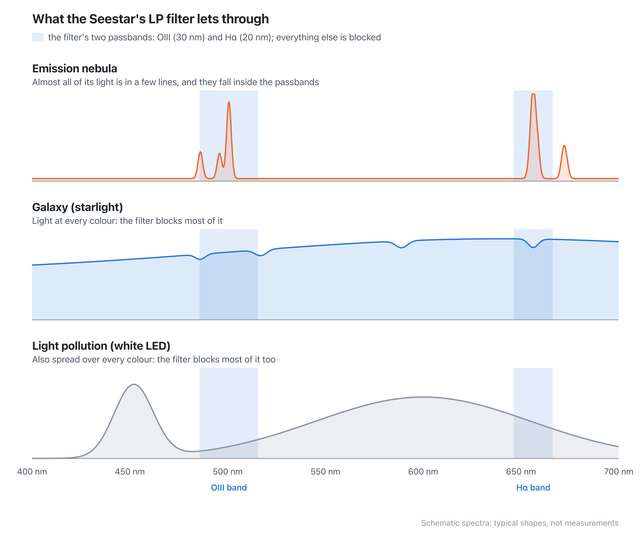
The Seestar's LP filter: when to use it, and when not
The Seestar's light-pollution filter is really a dual-band Hα and OIII filter. Why that makes it great for nebulae, wrong for galaxies, and still useful for galaxies.
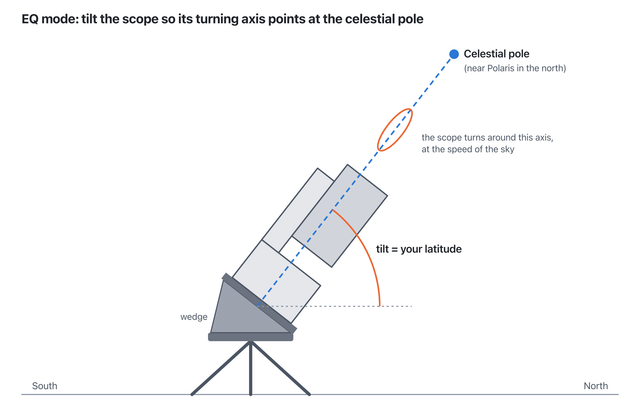
How to use EQ mode on a Seestar or Dwarf smart scope
Setting up equatorial mode on a Seestar or Dwarf 3, step by step: a rigid wedge or head, the tilt, the polar alignment, and the longer subs you get for it.
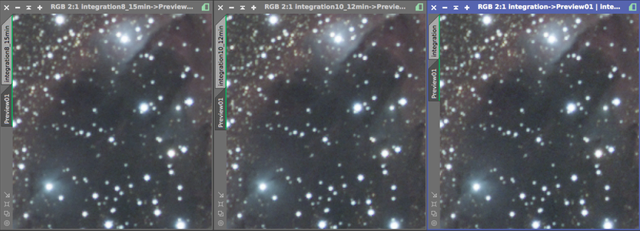
Longer exposures versus multiple shorter exposures
Many short exposures or fewer long ones? Under light-polluted skies it barely matters; under dark skies longer subs win on SNR. The maths and a dark-site test.
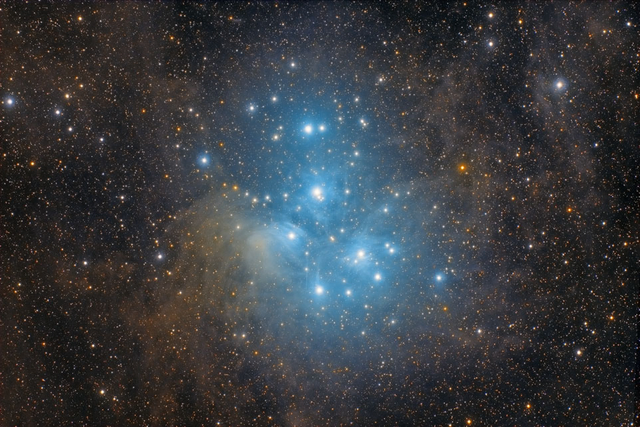
Imaging the Pleiades properly
The Pleiades look easy, but bright stars and faint dust make M45 a dynamic range challenge. Tips for capturing and processing it with colourful, unclipped stars.