 Owl Astro
Alt-az versus equatorial for astrophotography
For a long time this wasn’t much of a question for astrophotography. If you wanted to take long exposures of deep-sky objects, you bought an equatorial mount, learned to polar align and that was that. Alt-az mounts were for visual observing.
Smart scopes like the Seestar and the Dwarf changed that. They track in alt-az out of the box, they produce very nice images, and most owners never touch a polar alignment. Yet both now offer an equatorial (EQ) mode, and many people wonder whether they should use it. Is alt-az “good enough”, or are you leaving quality on the table?
As always, the answer is “it depends”. But it depends on things we can calculate, so let’s look at what actually happens.
Key takeaways
- An alt-az mount rotates your field of view during the night. An equatorial mount doesn’t.
- Field rotation hurts in two ways: stars trail at the corners within a sub, and the frames turn between subs, so the stacked image has to be cropped.
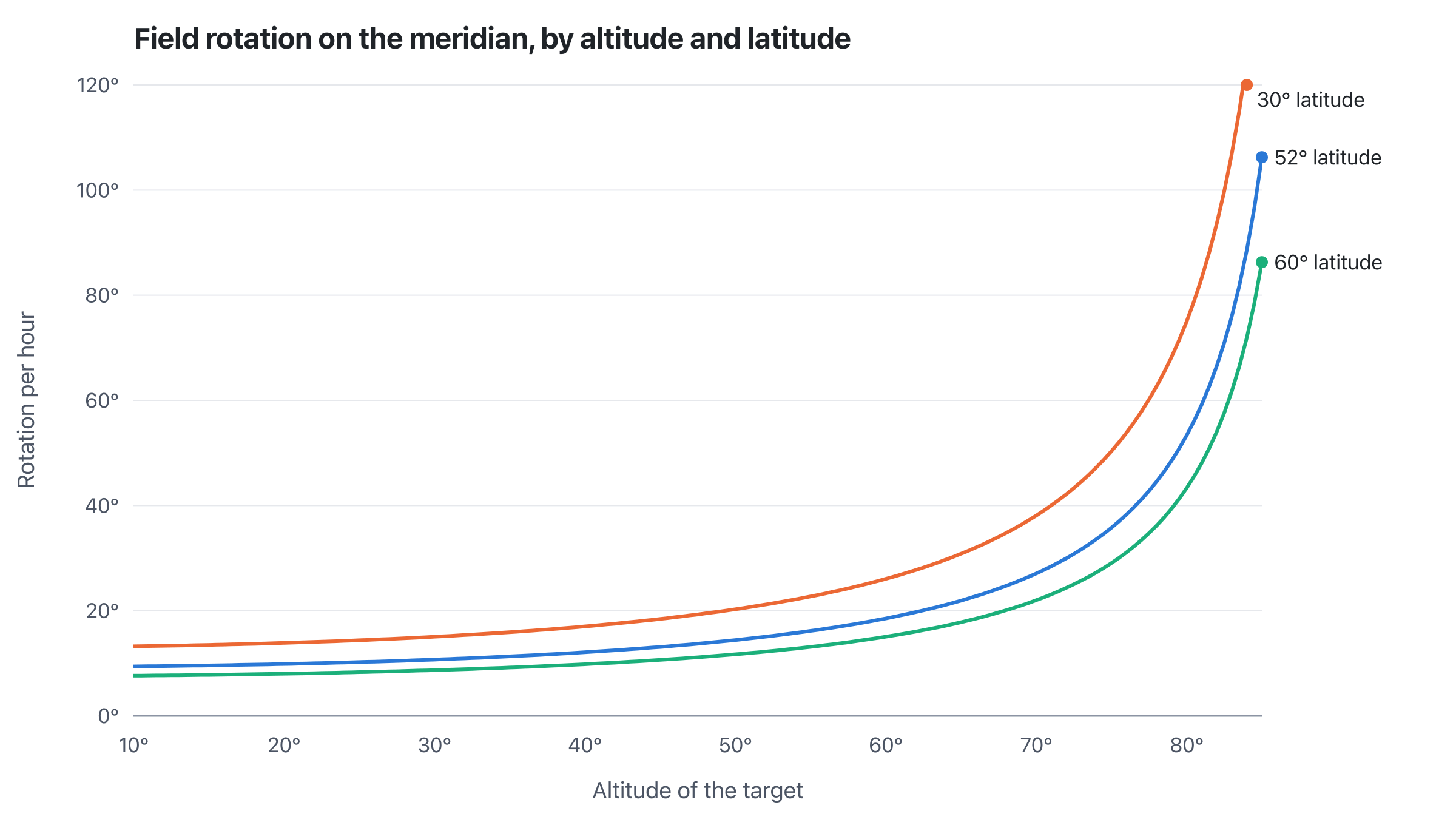
- How fast it rotates depends on where the target is, not on your telescope: fastest high up near the meridian, almost zero low in the east or west. Close to the zenith it becomes extreme.
- The trailing in pixels depends only on the rotation and your sensor’s pixel count, not on focal length. A 4K smart scope trails twice as many pixels as a 1080p one.
- Under light-polluted skies, short subs are fine and alt-az costs you very little. Under dark skies, longer subs pay off, and that’s when EQ mode is worth the trouble.
Two ways to follow the sky
An alt-az (altitude-azimuth) mount moves in two directions: up and down (altitude) and left and right (azimuth). It’s simple and intuitive, and it’s how a photo tripod head or a Dobsonian works. To follow a star across the sky, it has to move both axes at the same time, at rates that keep changing through the night.
An equatorial mount has one axis tilted to point at the celestial pole, parallel to the Earth’s axis. Stars circle around that pole, so to follow them the mount only has to turn that one axis at a constant speed: one turn per sidereal day. The price is the polar alignment: the axis has to point at the pole accurately, every time you set up.
Field rotation
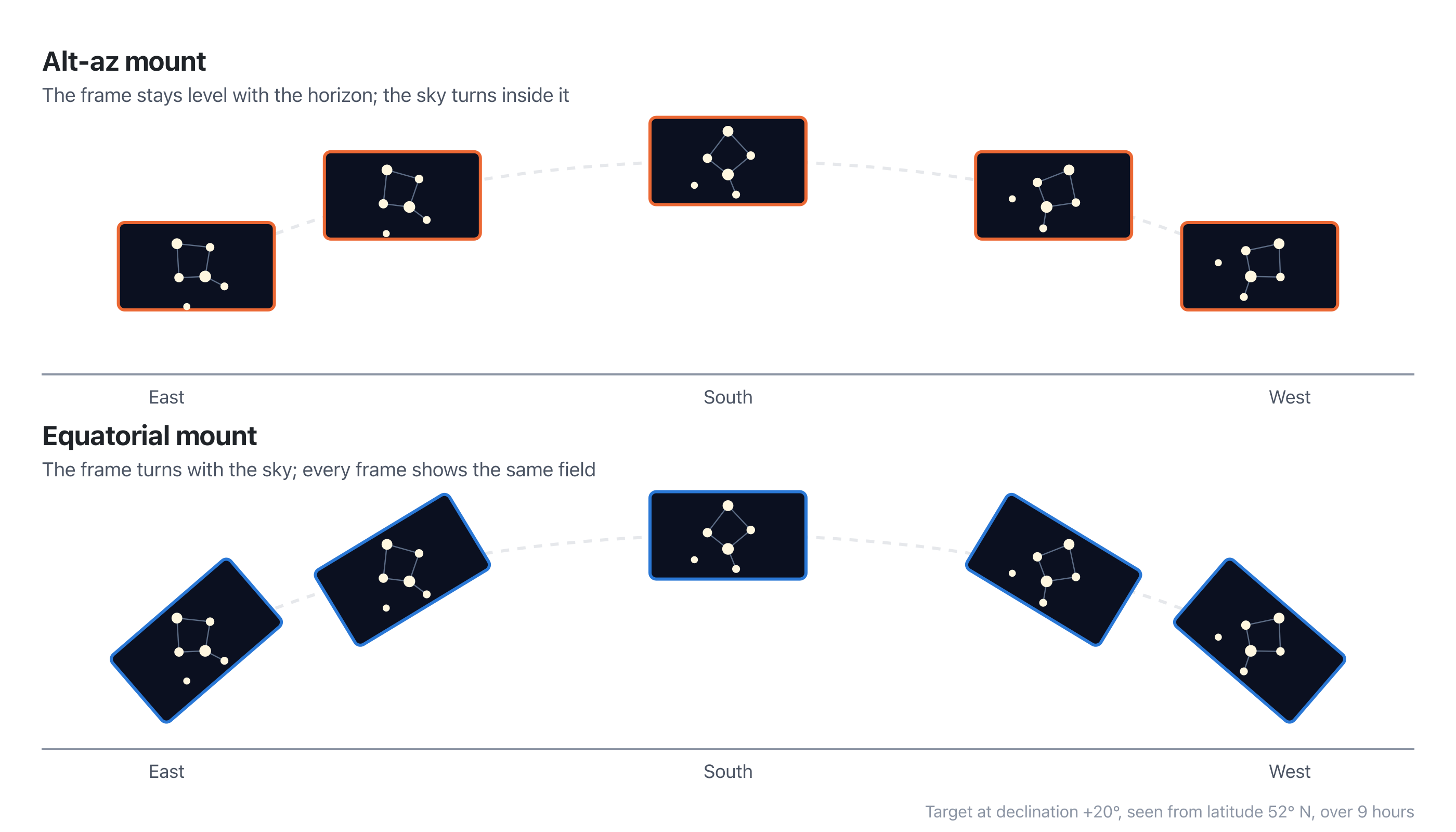
With both mounts the star stays in the centre of the frame. The difference is in what the frame does around it.
Picture a target rising in the east, passing high in the south and setting in the west. An alt-az mount keeps the bottom of your camera parallel to the horizon all night. But the sky itself doesn’t stay level: the constellation that rose “lying on its side” sets “on its other side”. Seen from the camera, the sky slowly turns around the centre of the image. That’s field rotation.
An equatorial mount turns the camera along with the sky, so the frame stays fixed on the target, all night.
The rotation rate of the field on an alt-az mount is:
where is the Earth’s rotation rate (15.04° per hour), your latitude, the target’s azimuth (measured from north or south, so on the meridian) and its altitude.
That formula tells us a lot:
- On the meridian, is largest: rotation is fastest when the target is due south (or north).
- Due east or west, : there’s practically no rotation at all.
- Higher up, gets small, so the rotation speeds up. At the zenith it becomes infinite: the mount would have to spin the field instantly.
- At higher latitudes, is smaller: field rotation is gentler at 60° north than at 30°.
To get a feel for the numbers, here’s the rate on the meridian at a latitude of 52° (the Netherlands, roughly):
| Altitude | Rotation |
|---|---|
| 20° | 9.9° per hour |
| 40° | 12.1° per hour |
| 50° | 14.4° per hour |
| 60° | 18.5° per hour |
| 70° | 27.1° per hour |
| 80° | 53.3° per hour |
| 85° | 106° per hour |
So a target that transits at 60° turns about 18° every hour around the meridian, and a target passing close to the zenith can turn more than a degree per minute.
What field rotation does to your images
Within a sub: trailing in the corners
During a single exposure the field turns around its centre. The centre doesn’t move, but the further from the centre, the further a star travels. The corners suffer most.
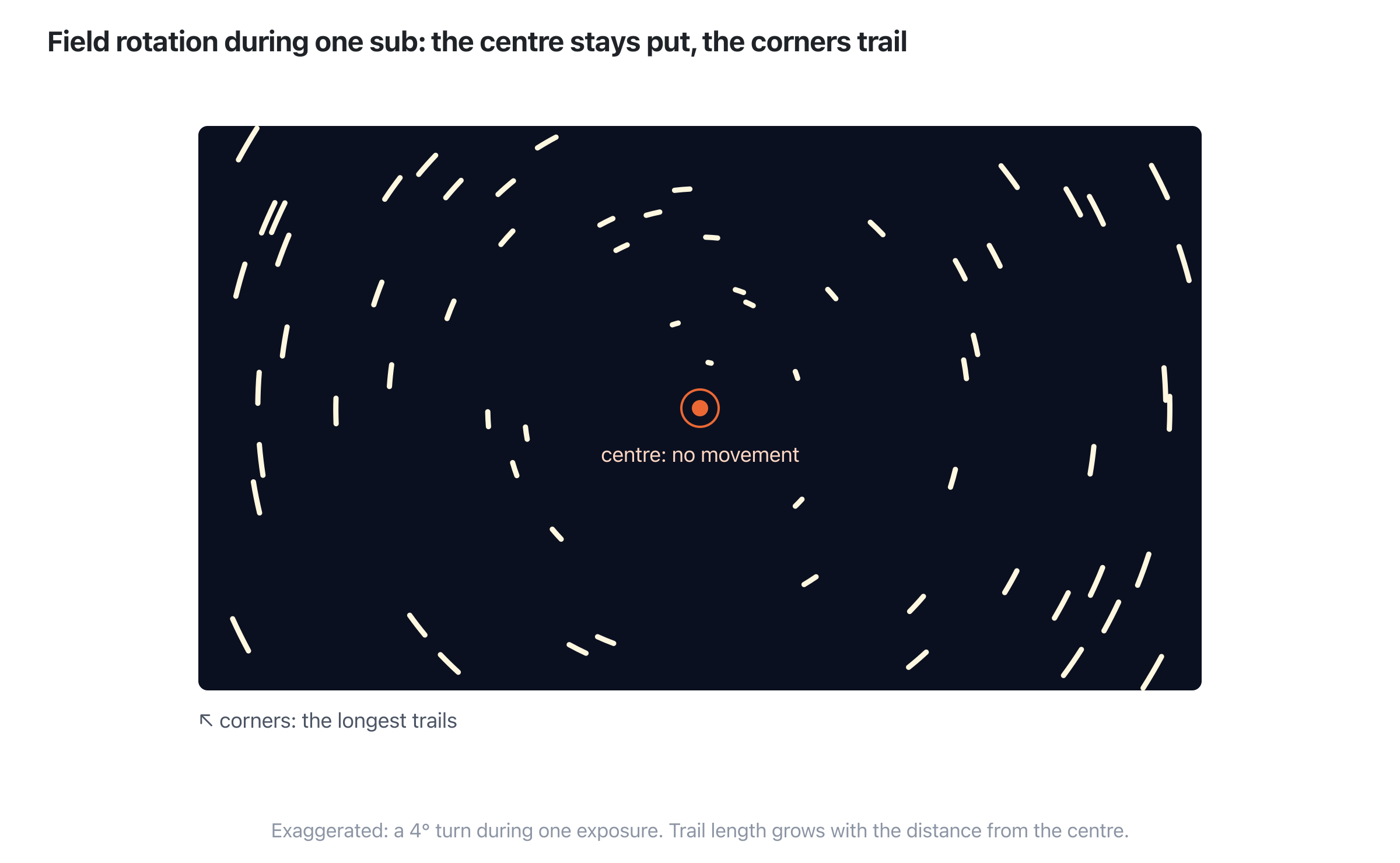
How far a corner star moves, in pixels, is simply the angle the field turned during the sub (in radians) times the distance from the centre to the corner, in pixels:
Notice what’s not in there: focal length. A longer focal length magnifies the stars, but it also magnifies the motion by exactly the same amount. What counts is how many pixels the sensor has from centre to corner. A 1920 × 1080 sensor has about 1,100 pixels from centre to corner; a 3840 × 2160 sensor about 2,200. So a 4K sensor trails twice as many pixels as a 1080p sensor, on any telescope.
For a 4K smart scope (Seestar S50 Pro, S30 Pro, Dwarf 3) at 52° north, on the meridian:
| Sub | Target at 50° | Target at 70° |
|---|---|---|
| 10 s | 1.5 px | 2.9 px |
| 20 s | 3.1 px | 5.8 px |
| 30 s | 4.6 px | 8.7 px |
| 60 s | 9.2 px | 17.3 px |
For the original 1080p Seestar S50, halve these numbers.
Stars in these scopes are typically 2 to 4 pixels wide, so a smear of a pixel or so is hardly visible, while 3 pixels or more gives clearly elongated stars in the corners. That’s why smart scopes keep to short subs in alt-az (up to 30 seconds on a Seestar), and why their longest exposure settings need EQ mode.
Between subs: the stack has to be cropped
Smart scopes (and stacking software like PixInsight or Siril) rotate every frame back into line before stacking, so the stacked image itself isn’t rotated. But the frames don’t all cover the same patch of sky anymore: each one is turned a bit further than the previous one. Only the area that’s in every frame got the full integration time; towards the edges and corners you get fewer and fewer frames, so more noise.
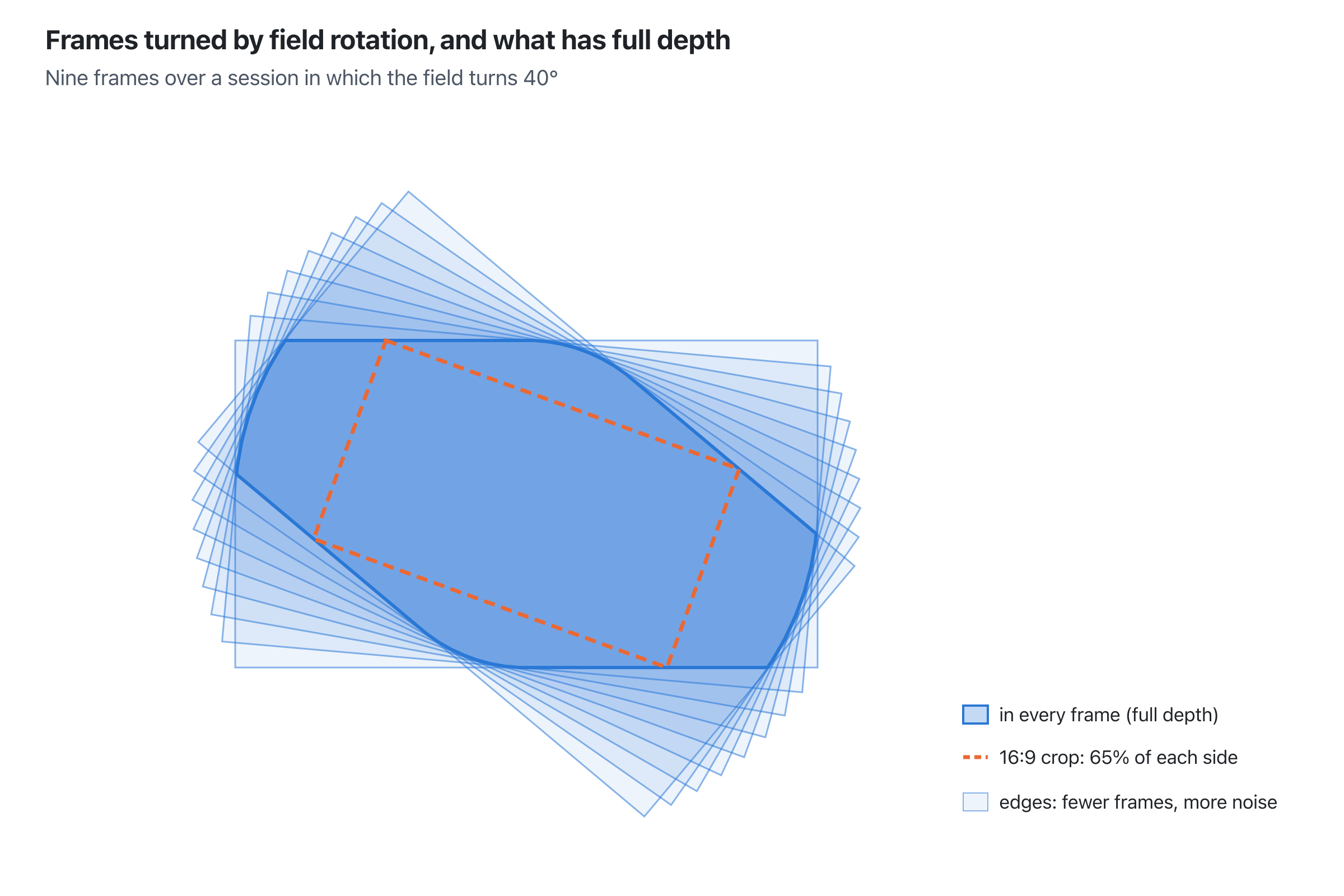
Over a long session that adds up. If the field turns 40° during your session, a 16:9 frame has to be cropped quite a bit to keep only the part with full depth. Smart scopes handle this for you, but the price is a smaller usable field, or noisy corners.
An equatorial mount doesn’t have this problem at all: every frame covers exactly the same field (apart from small shifts from dithering and tracking).
When does it matter?
Field rotation is a real effect, but whether it matters depends on the sub length you actually need. And the sub length you need depends mostly on your sky.
As I showed in Longer exposures versus multiple shorter exposures, under light-polluted skies the sky noise buries the read noise within seconds. Smart scope sensors have very low read noise (around 1 electron), so under a typical suburban sky, 10 or 20-second subs lose you practically nothing compared with longer ones. Total integration time is what counts. In that situation alt-az is perfectly fine, and EQ mode mostly saves you some cropping.
Under a dark sky it’s different. The sky background is so faint that short subs are dominated by read noise, and longer subs give a real SNR improvement. The same goes for narrowband or dual-band filters, which turn any sky into a dark one. That’s where alt-az’s limit of short subs starts to cost you, and EQ mode pays off.
The other things that make EQ mode more worthwhile:
- Targets that pass high overhead. The higher the target transits, the faster the rotation (see the table above). Close to the zenith, alt-az struggles even with short subs.
- Long sessions and multi-night projects. The more the field turns over the total integration, the more you lose to cropping. With EQ every night lines up with the previous one.
- A sensor with more pixels, as we saw: the trailing in pixels scales with the pixel count.
- Mosaics, where every panel needs to cover its planned piece of sky, edge to edge.
And the things that make alt-az the better choice:
- Bright skies, where short subs are all you need anyway.
- Quick sessions, or grab-and-go observing: no polar alignment, set up in a minute.
- Targets low in the east or west, where field rotation is small anyway.
- No view of the pole, or no way to tilt your setup steadily.
Equatorial mounts have downsides too
To be fair to alt-az: equatorial mounts aren’t free of compromises.
- Polar alignment takes time, and every error in it shows up as drift. Smart scopes make this much easier than it used to be, but it’s still an extra step.
- Meridian flip. A German equatorial mount has to flip to the other side when the target crosses the meridian, which interrupts your session and turns the frame 180°.
- Stability. A tilted setup is less stable, especially for a smart scope on a photo tripod. A wedge or a sturdy tilting head is a must, and wind matters more.
Conclusion
Field rotation is not a reason to avoid alt-az. Under typical light-polluted skies, with the short subs those skies allow, the trailing is small and the smart scope crops away the rest. For many people alt-az is simply the best way to get the most clear nights out of their scope.
But when you go to darker skies, use narrowband filters, image targets that pass high overhead or put a lot of hours into one target, it’s worth going equatorial. You get longer subs without trailing, a full uncropped field, and nights that line up with each other.
If you use a smart scope, I’ve written a separate guide on how to set up EQ mode on a Seestar or Dwarf.
Comments
Loading comments…