 Owl Astro
Longer exposures versus multiple shorter exposures
First published on DSLR Astrophotography, revised for Owl Astro.
Which is better: many short exposures or fewer long exposures? 120 × 1 minute or 10 × 12 minutes? This gets asked all the time and receives all kinds of answers. People bring up the camera, the faintness of the signal, dithering, stacking, light pollution and so on, until it starts to sound like a matter of opinion. Is it really that complicated, or is there a definitive answer?
It turns out that although there are formulas for the ideal (theoretical!) exposure time, practicality and personal preference come into play when you choose the exposure you actually use.
Knowing how subexposure time affects the SNR of your stacked image helps you make that choice. We’ll work our way to an optimum exposure time, which involves quite a bit of maths. Going through the maths and calculating the SNR for a few scenarios helped my own understanding a lot, so I encourage you to follow along. If you’re mostly interested in the conclusions, here they are first.
Key takeaways
- Under light-polluted skies, don’t worry about exposure time. It makes little to no difference whether you use 30-second or 3-minute subexposures. Total integration time is what matters.
- Under dark skies, longer exposures improve SNR. It’s not worth going to extremes, though, and remember the cost of throwing out a subexposure because of poor tracking. Only increase exposure time if you can reliably track that long.
- If you don’t use darks, or want to use dithered (Bayer) drizzle integration, make sure you get at least 10 to 15 subexposures.
Now let’s see why, and how we arrive at these conclusions.
Read noise and background sky flux
Finding the optimum exposure comes down to two factors: read noise and background sky flux.
Read noise is the noise added by the camera’s electronics when the electrons from the sensor are converted to digital units (ADU) and stored. Background sky flux is the signal from light pollution, moonlight and airglow. The background is never completely black, and its value is the background sky flux.
If the read noise is swamped by sky background noise it becomes irrelevant, and it doesn’t matter how long our subexposures are.
Without read noise, one very long exposure and many shorter exposures with the same total integration time would give the same result. Without background sky noise but with read noise, the longer exposure would always win.
In reality we always deal with a mixture of the two: there is always some sky background, and read noise always counts, especially for us DSLR users. So the question becomes: at what point does the sky background noise make the read noise irrelevant? Past that point, it no longer matters whether we take many shorter or fewer longer exposures.
If you image under strong light pollution, this probably applies to you. If you use narrowband filters or image under truly dark skies, you will practically never reach that point, and longer exposures will always be better.
Let’s look at why, and at some test results.
Adding multiple exposures and SNR
What exactly happens to the SNR when we add multiple exposures, and when we expose longer? We’ll go through the maths step by step. Many articles skip steps and rewrite formulas without explaining how or why; I’ll try to avoid that.
SNR is simply signal divided by noise. With several noise sources, though, we need to look at how noise adds up. First, let’s define the signal: signal per second () times exposure time () times number of exposures ():
This is the total signal recorded over all exposures.
The noise sources are object shot noise, sky (shot) noise, dark current noise and read noise. Whenever we detect photons we get shot noise, which is the square root of the number of photons. Like the signal, it builds up over time. The object shot noise belongs to the signal of the object we’re imaging and is the square root of that signal:
Sky shot noise is the square root of the background signal from the sky:
Dark current noise is the square root of the thermal signal (dark current) that builds up:
Read noise is different: it doesn’t build up over time, but it occurs once for every exposure. This is important. The total read noise () is:
Random, uncorrelated noise adds quadratically, so the total noise is:
Since shot noise is the square root of its signal, squaring it gives back the signal, so we can write the noise in terms of the signals:
appears in every term, so we can take it out:
So the SNR is:
appears above and below the line, and since we can rewrite this as:
With the SNR in this form, we can explore the effect of background sky flux and read noise.
Scenario with no read noise
You may already see what we said earlier: without read noise, exposure length doesn’t matter as long as the total exposure time is the same. Take read noise out of the equation:
Now appears in every term under the root, so we can group it:
and since :
The SNR depends only on , so it doesn’t matter how we split the total exposure time into subexposures.
But what about really faint signal? Don’t you need very long exposures for that? Not without read noise. You need a (very) long total exposure time. That might feel counterintuitive when you think of stacking as averaging: the average of a few electrons spread over many frames is smaller than a few electrons in one frame. True, but that only considers signal. Signal on its own isn’t useful; only SNR determines whether a detail stands out in the image. Since SNR is signal divided by noise, splitting the detection over more frames divides both by the same factor, which changes nothing: .
So without read noise, only total integration time matters. And even with read noise in the formula, once the other terms are much, much larger than it, the same applies.
Once the other noise sources are much, much larger than the read noise, the read noise becomes (almost) irrelevant, and it doesn’t matter which exposure time you use.
Scenario with little to no sky noise
Now consider a truly dark sky: no light pollution, no moonlight and only a little airglow, so very little background sky signal (). Back to the SNR formula:
Let’s say the target signal = 1 e⁻/s, = 0.04 e⁻/s, = 0.15 e⁻/s (as reported for the Nikon D7000) and read noise = 3 e⁻ (Nikon D7000 at ISO 200). We’ll compare a total integration time of 120 minutes as 120 × 1 min and as 12 × 10 min.
120 × 1 min:
12 × 10 min:
The SNR is higher, as expected. What if we take it to the extreme with a single 120-minute exposure?
1 × 120 min:
That’s only a small improvement over 12 × 10 min: a clear case of quickly diminishing returns. This graph shows the SNR gain over a 30-second exposure for exposures between 30 seconds and 120 minutes:
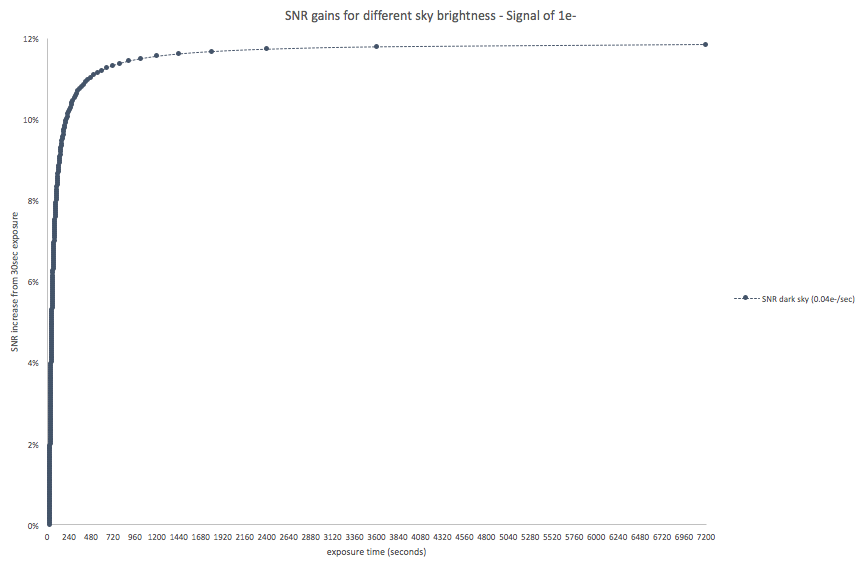
Under a dark sky, the gain from exposing longer is large at first and reaches 10% at 3.5-minute exposures compared with 30 seconds. It tails off quickly: at 8 minutes it’s only 1% more. In other words, going from 3.5 to 8 minutes (same total integration time) improves SNR by slightly less than 1%.
These gains also depend on the signal from the target. For a much fainter object with a flux of only 0.2 e⁻/s instead of 1 e⁻/s, we get:
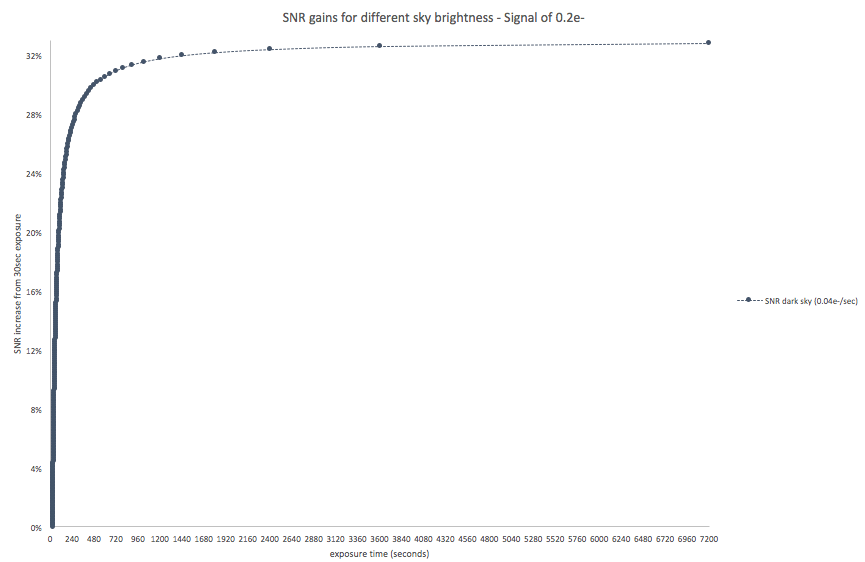
The same diminishing-returns curve, but the improvements for a fainter signal are much higher. At the same marks: 3.5-minute exposures improve SNR by 26.3% over 30 seconds, and going from 3.5 to 8 minutes adds another 2.86%. Between 8 and 15 minutes the gain is still 1%. So the returns still diminish, but the improvements stay significant up to longer exposures.
Note that we’re talking about the signal arriving at the sensor here, so this covers slow optics as well as fast optics on very faint targets.
The role of read noise
To make the role of read noise really clear, let’s see how it adds up as we add exposures. Take the same 12 × 10 min versus 120 × 1 min situation and look at the noise terms separately.
For object shot noise, sky noise and dark current noise together:
12 × 10 min:
120 × 1 min:
Exactly the same, as in the scenario without read noise.
The read noise is :
- 12 × 10 min:
- 120 × 1 min:
So read noise grows with the square root of the number of exposures, while all the other terms grow with total exposure time alone. For a fixed total exposure time, read noise is smallest with the fewest exposures.
Read noise grows with the square root of the number of exposures in your integration.
Adding the noise quadratically gives the total:
- 12 × 10 min:
- 120 × 1 min:
That shows how much read noise matters here. Now compare a bright sky with a background flux of 50 e⁻/s. The time-dependent noise sources give:
Adding read noise:
- 12 × 10 min:
- 120 × 1 min:
A completely different situation: the read noise is practically irrelevant, much like the hypothetical case without read noise.
Exposure time only matters when read noise matters, and read noise only matters when the sky is dark enough.
Determining the optimal exposure time
So what applies to your situation? As we just concluded, that mostly depends on how bright your sky is.
There are formulas that give an optimum exposure from read noise and sky flux, and PixInsight has a script that gives an “ideal exposure length” (Scripts → Instrumentation → CalculateSkyLimitedExposure). But as the graphs show, the SNR benefit is one of diminishing returns, so there’s no single absolute answer. You have to decide how much read noise contribution you’ll tolerate, and the assumptions people make about that differ hugely (by factors of two). These formulas also ignore practicalities.
So instead, here are the SNR gains over 30-second exposures for several sky brightnesses, with 2 hours total exposure time. The “95% improvement mark” is labelled for each sky:
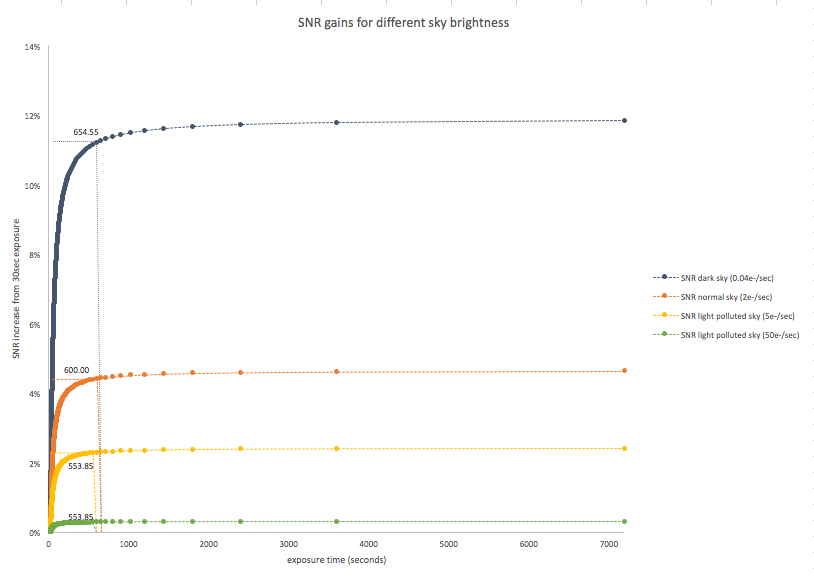
The most obvious lesson: you benefit far more from longer exposures under a dark sky than under brighter skies. The 95% marks look close together for all skies, but I’m not sure how useful that is: one step beyond it still gains 0.05% under a dark sky and only 0.0012% under the brightest one. In the brightest scenario, the SNR was 11.83 at 30 seconds and 11.86 with a single 120-minute exposure. There, subexposure length is completely irrelevant.
We saw earlier that fainter signals benefit much more, so here’s the same comparison for the faint 0.2 e⁻/s signal:
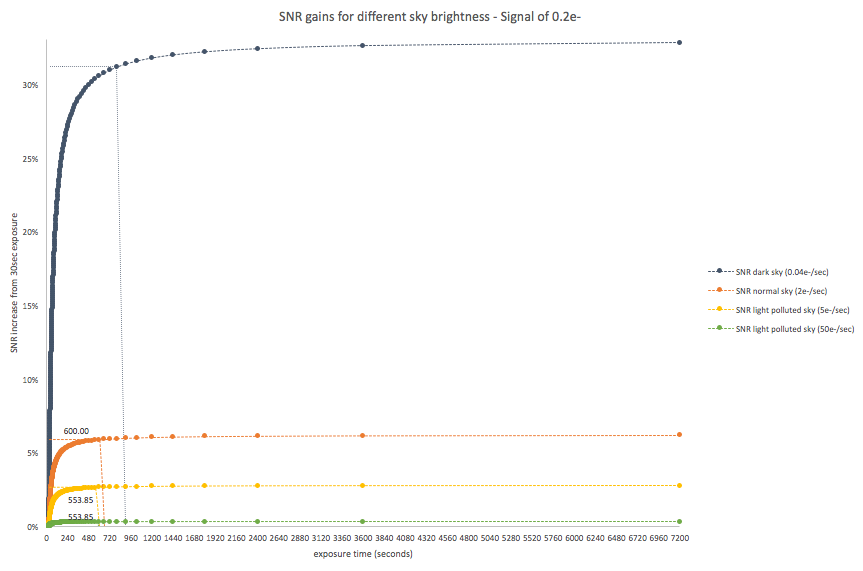
Sky brightness matters just as clearly here. Fainter signals benefit somewhat more from longer exposures under brighter skies too, but the difference is negligible under a very bright sky and huge under a really dark one.
So if you image under a light-polluted sky, don’t worry much about exposure length. For every sky brightness between 5 and 50 e⁻/s the total SNR improvement is between 0.2% and 2%, and you reach 80% of it with 3-minute exposures.
Other practical considerations
Beyond read noise and sky flux, some practical factors matter too. Can you guide accurately for longer exposures? What does it cost to throw out a subexposure? Since total integration time matters most for SNR, losing subexposures has a real cost. And if you want to use (Bayer) drizzle integration, you need a minimum number of dithered subexposures to get good results.
These can change the optimal exposure time for you completely.
Light pollution and narrowband filters
I’ve been asked a lot about filters. I haven’t tested this myself, but The Astrophotography Manual by Chris Woodhouse compares several light-pollution filters and found that, surprisingly, they didn’t affect the background sky flux all that much. As always, test it to be sure, but I expect light-pollution filters to have little effect on how much read noise contributes to the total noise.
Narrowband filters, on the other hand, turn even a light-polluted sky into a dark(er) one. With narrowband filters you benefit a lot from longer subexposures.
There are exceptions, such as OIII imaging under a full moon, and the details depend on things like the speed of your scope and the quantum efficiency of your camera. But the generalisations hold in most situations.
A comparison from a dark site
Here’s data I shot in Namibia, with practically no light pollution and no moon. The only background sky flux was airglow and perhaps a little zodiacal light.
The data comes from three nights, so some variation from conditions is possible, but there were no noteworthy differences between them, so I don’t think it affects the comparison much.
I used three exposure lengths: 8, 12 and 15 minutes. For this comparison I made three integrations of 120 minutes each: 15 × 8 min, 10 × 12 min and 8 × 15 min. No processing, just a screen stretch (STF) to make the data visible.
Based on the above, we’d expect the fewer, longer exposures to have the best SNR. Let’s see.
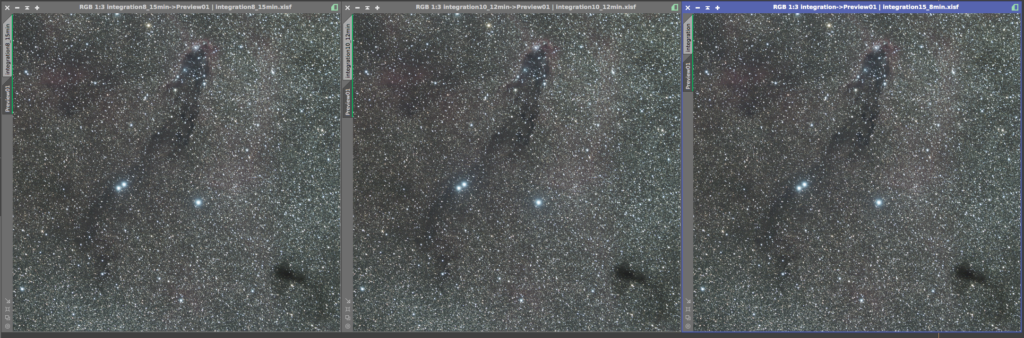
Hard to tell from the wide view, so let’s zoom in.
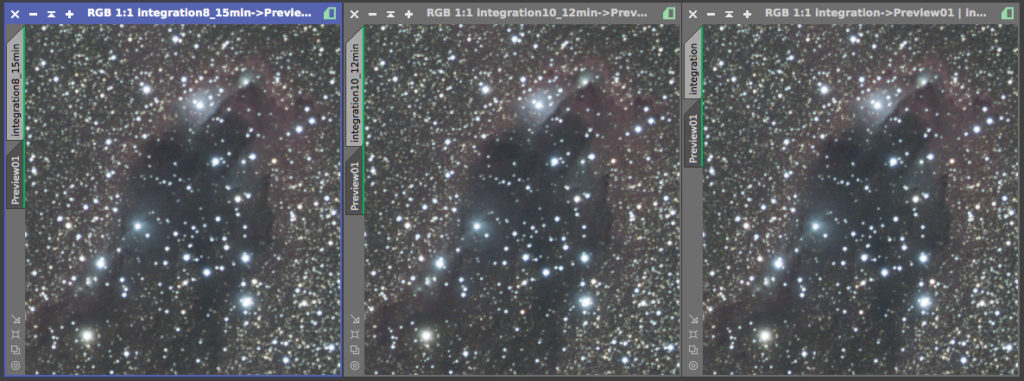
Some difference in noise is visible already. Zooming in further:
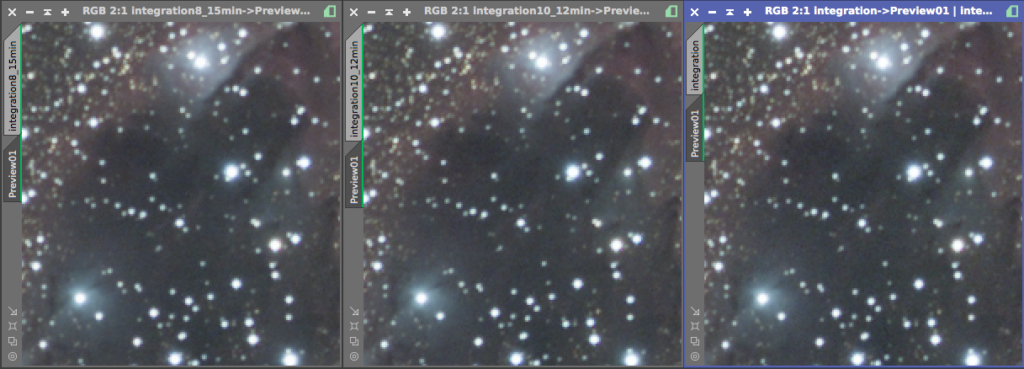
Now the difference is clear, and as expected: 8 × 15 min looks (much!) better than 15 × 8 min. It’s even more visible in the dark region of Barnard 44A:
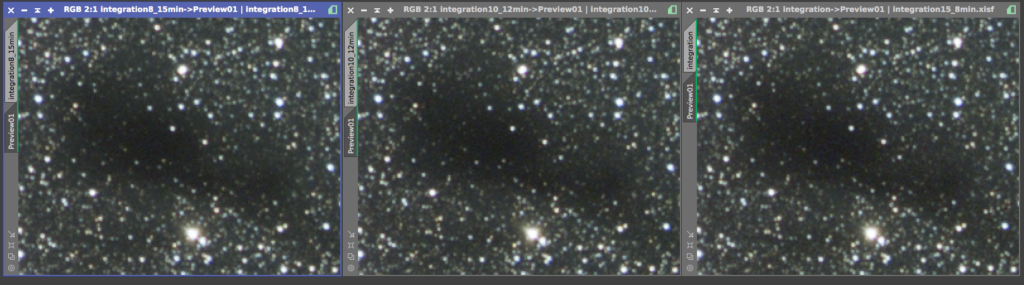
Visually, longer exposures win in this clearly read-noise-limited situation. Let’s check the numbers, starting with the noise:
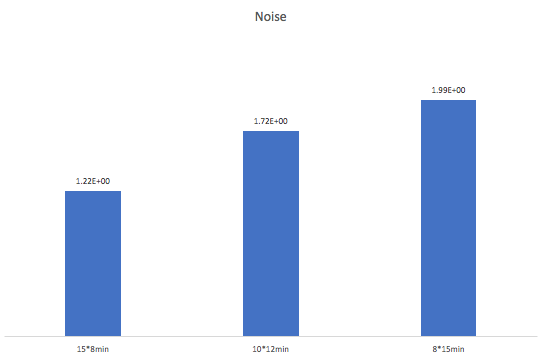
Noise is higher for the longer exposures, as expected. The question is whether the signal grew more than the noise. Here’s the SNRWeight measure (a relative measure, not the actual SNR difference):
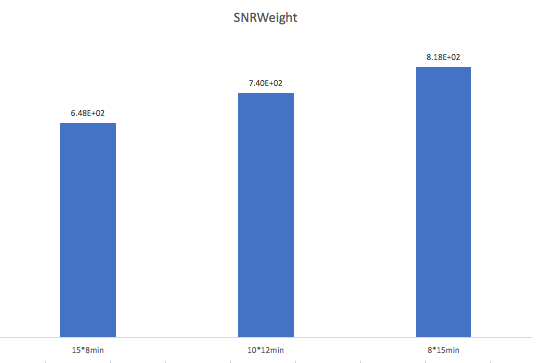
It clearly did.
Unless you’re under dark skies, subexposure length won’t matter much once you’re using 2 to 3-minute exposures.
Conclusion
Between the maths, the simulations and the dark-site test, we have a good picture of the optimal subexposure length. Exactly what’s optimal for your situation remains hard to say, and many details go out the window once drizzle integration and guiding errors enter the picture.
The most important conclusion: exposure length only matters when read noise matters, and read noise only matters under a dark sky. Under moderately to strongly light-polluted skies, subexposure length won’t matter much once you’re using 2 to 3-minute exposures.