 Owl Astro
Nikon vs Canon for astrophotography
First published on DSLR Astrophotography, revised for Owl Astro.
I have to admit that I didn’t choose a Nikon D7000 for astrophotography because it was the best option. I already owned one for daytime (wildlife) photography when I started. It turned out to perform very well, so I stuck with it, and when I bought a second body I went for a D5100: the same sensor in a smaller, cheaper camera.
This time I did look at the comparisons. So let’s look at the question every DSLR astrophotographer runs into: Canon or Nikon?
2026 note: the data below is from DxOMark tests in 2014, and the prices are launch prices. Most of these cameras are now only available second-hand, and many imagers have since moved to mirrorless bodies or dedicated astro cameras. The models have changed, but the method holds: look at measured sensor performance, not at what everyone else uses.
Key takeaways
- Canon is the most used DSLR brand in astrophotography, but not because of its sensors. Software support and Canon’s astro-modified models made it the default.
- In the 2014 sensor tests, many Nikon models outperformed Canon on colour depth, dynamic range and low-light ISO score, at similar prices.
- Decide on what matters for how you work: standalone or with a laptop, software and guider compatibility, sturdiness, and whether you want the camera modified.
Choosing the right camera
When you pick a DSLR for any kind of photography, think about which specifications and characteristics matter to you. There’s no single best camera for astrophotography: every photographer works differently, even within something as specific as astrophotography.
For me, one of the main advantages of a DSLR is that I can work standalone, without a laptop in the field. That makes Live View and the camera’s screen more important to me than to someone who controls the camera from a laptop. It also makes driver and software compatibility less of a concern, which is probably the main reason I could consider Nikon at all instead of the “standard” astrophotography brand, Canon. (Since then, BackyardNikon has made software support a non-issue for Nikons too.)
I also care about how sturdy a camera is. I don’t want to worry when it’s dripping with dew, or when I drop it because I didn’t tighten the focuser screws (it happened to me, ouch!).
And then there are the usual sensor considerations: how well it handles the different kinds of noise, colour depth, dynamic range, pixel size, and sensor size for your field of view.
Nikon vs Canon: which is best?
To me, astrophotography has become too Canon-minded. Because compatible software was available, and perhaps because of Canon’s astro models like the 60Da, Canon became the first choice for almost everyone imaging with a DSLR. But if we look objectively at camera performance, and especially at the sensor, we can’t help but conclude that the Nikons were outperforming the Canons.
That may sound like what any Nikon owner says in a Nikon vs Canon discussion, so let’s look at some objective data from DxOMark’s sensor tests.
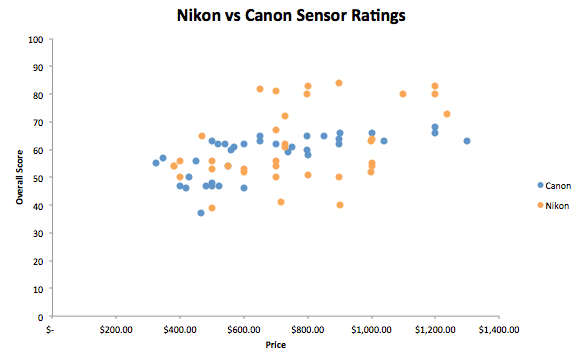
A whole range of Nikon models consistently outperforms the Canon models on the overall sensor score. DxOMark looks at three things to rate a sensor: colour depth, dynamic range and low-light ISO performance. All three are very relevant for astrophotography too.
I’ve limited the view to cameras under about $1,300 to get a clearer picture. Remember that these are launch prices: older models are cheaper, which we’ll come back to.
Let’s look at the three scores one by one.
Colour depth
DxOMark describes colour depth as how subtly the sensor can tell colour nuances apart, expressed as the number of bits of colour it can distinguish.
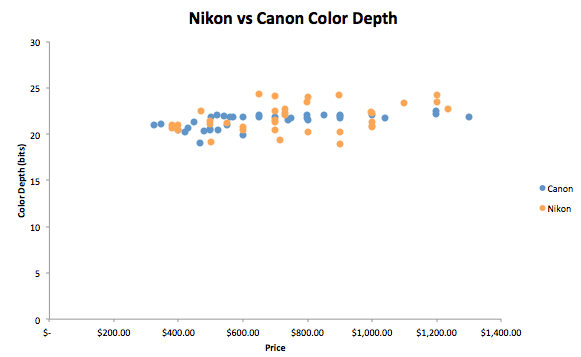
Colour nuance, especially in star colours, is overlooked a lot in astrophotography. In my opinion there’s too much focus on detail, sharpness and noise.
Dynamic range
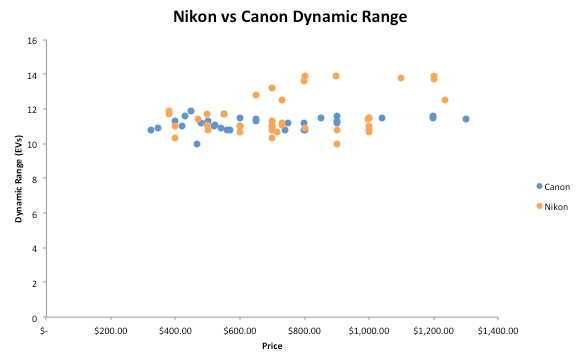
Closely related to star colour is dynamic range: the range between the brightest light the sensor can record before it saturates and the faintest light it can still separate from noise. DxOMark expresses it in EV (stops), where each stop doubles the amount of light. 12 EV is excellent; differences under 0.5 EV are usually not noticeable.
Low-light ISO
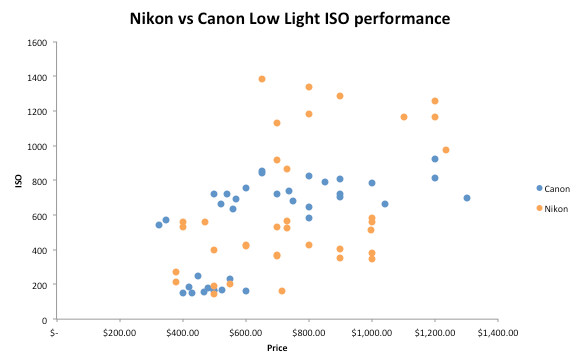
Both colour depth and dynamic range drop quite dramatically as you raise the ISO. Since astrophotographers always shoot at raised ISO, the low-light ISO score is arguably the most important of the three. It tells you up to which ISO a camera keeps a signal-to-noise ratio of 30 dB, with at least 9 EV of dynamic range and 18 bits of colour depth. In that sense it takes the other two scores into account.
Note that this is not the best ISO to use for astrophotography in most cases: see What is the best ISO for your DSLR for astrophotography? for that.
A top 10 of DSLRs for astrophotography
That raises the question which models perform best. Here’s the top 10 by low-light ISO score, which is only slightly different from the top 10 by overall score.
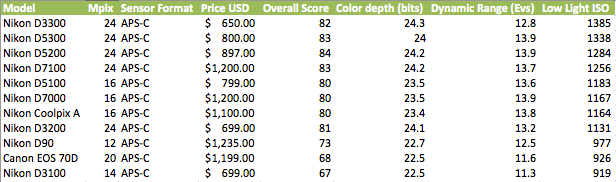
Also look at what these models cost now, and how easy they are to find second-hand.
Disadvantages of Nikon for astrophotography
Nikons are compatible with less software and equipment than Canons. Whether that’s a problem depends on your gear and software. For me it isn’t, because I don’t control the camera from a laptop, and I can use my Lacerta MGEN autoguider with the D7000.
Another possible disadvantage is that Nikon bodies are modified (for better H-alpha response) less often than Canon bodies. That can make it harder to find someone experienced to do it. It can be done, though, so it doesn’t have to be a problem.
Conclusion
Canon is clearly the most used DSLR in astrophotography, but you can reasonably argue that it isn’t the best choice for many people. When you buy a DSLR, most of what you need to consider depends on your gear and on how you like to work in the field. Get a clear picture of what matters to you, look at actual sensor performance, and you might very well end up with a Nikon.